
Search & Relevance
How Nowledge Mem finds and ranks your memories
How Nowledge Mem finds matching memories, ranks them by relevance, and learns from your usage patterns.
The Scoring Pipeline
Search combines multiple signals to rank results beyond keyword matching.
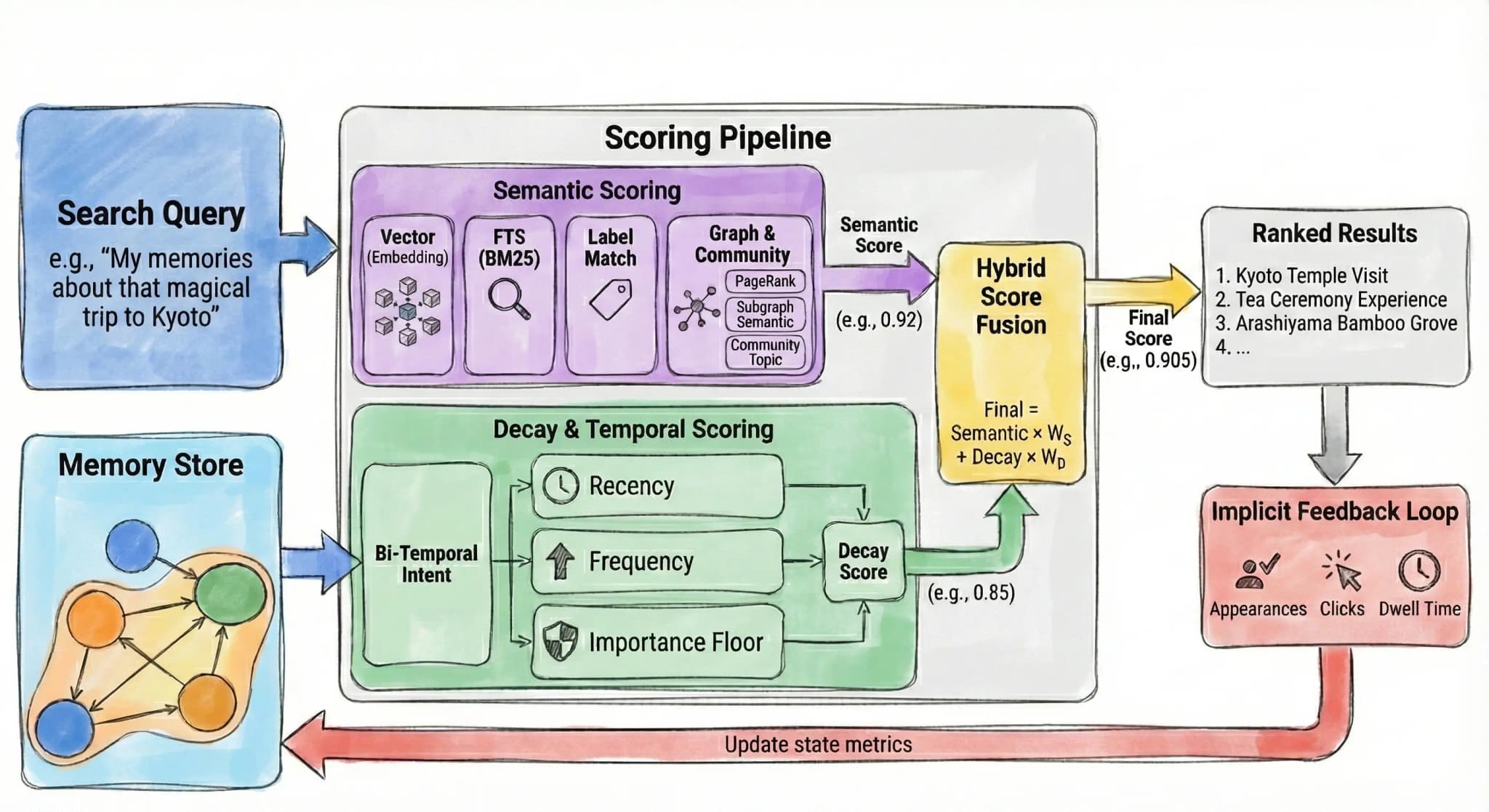
Semantic Scoring
This track finds memories that match what you're looking for:
- Meaning-based search: Finds memories by semantic similarity, not just exact words. Search for "design patterns" and find memories about "architectural approaches."
- Keyword search: Catches exact phrases and technical terms using BM25 ranking.
- Label matching: Surfaces memories with matching tags.
- Graph traversal: Discovers connected memories through entities and topic communities.
Decay, Confidence & Temporal Scoring
This track adjusts results based on freshness, validation, and your usage:
- Recency: Recently accessed memories score higher. We use exponential decay with about a 30-day half-life.
- Frequency: Memories you access repeatedly become more durable (logarithmic scaling with diminishing returns).
- Importance floor: High-importance memories maintain minimum accessibility even when unused.
- Confidence: Memories that have been validated through usage and knowledge-graph connections get a subtle boost. Confidence grows with evidence and never decreases.
- Temporal matching: Boosts memories whose event time matches your query (deep mode only).
These tracks combine into a final score that determines result ranking.
Memory Decay
Memories fade over time unless reinforced by use.
How It Works
Recency: A memory accessed yesterday scores much higher than one from three months ago. The 30-day half-life means scores roughly halve each month without access.
Frequency: Your 10th access to a memory matters more than your 100th. This mirrors how human memory works: early repetitions build durability, later ones have diminishing returns.
Importance Floor: Memories marked as high importance never fully decay. Even untouched, they maintain minimum accessibility. This protects foundational knowledge from fading away.
Search Reinforcement
Since v0.6.6
Starting from v0.6.6, every search appearance updates a memory's last-accessed time and access count, strengthening its freshness score automatically.
Previously, only explicit clicks updated freshness. Now, appearing in search results counts as a light access, keeping actively relevant memories from fading.
Confidence
Since v0.6.7
Confidence scoring is computed during the daily freshness refresh.
Separate from decay, each memory builds a confidence score that reflects how well-validated it is. Confidence starts at a baseline and grows as evidence accumulates:
- Search usage: Appearances, clicks, and reading time
- Knowledge graph: Memories confirmed or enriched by other memories, or used as sources for crystallized knowledge
Unlike decay which fades with time, confidence only increases. A memory that has been frequently accessed, clicked, and connected to other knowledge scores higher than a freshly created one with the same semantic match.
The influence is subtle (confidence contributes about 5% of the final score), but it gives well-established knowledge a consistent edge.
What This Means
- Active knowledge stays fresh, including memories that appear in search results
- Old memories don't disappear, they just rank lower when equally relevant
- Important knowledge persists regardless of access patterns
- Well-validated memories get a subtle ranking boost
- The system learns from your behavior automatically
Automatic Maintenance
Since v0.6.6
These features are opt-in via Settings → Processing → Advanced.
To keep decay scores accurate and memory quality high, Nowledge Mem can run background maintenance:
- Freshness refresh: A daily task recomputes decay and confidence scores across all memories, so ranking stays current even for memories you haven't touched recently. This changes scores only; it does not archive, merge, delete, or rewrite memories.
- Memory Maintenance: A review-first task looks for memory growth pressure. It can prepare a Timeline review for stale low-risk facts/events that could move out of everyday recall, and for protected knowledge that may need semantic organization.
- Compaction: A weekly task identifies clusters of similar or redundant memories and can create links, summaries, or review items. It never silently deletes your saved memory text.
Temporal Understanding
Nowledge Mem understands two kinds of time.
Event Time vs Record Time
Event time is when something actually happened:
- "The 2020 product launch"
- "Last quarter's decisions"
- "Before we migrated"
Record time is when you saved the memory. You might record a memory today about an event from 2020.
This matters for queries like "recent memories about 2020 events": things you saved recently (record time) about events from 2020 (event time).
Temporal Intent Detection
Deep Mode Feature
Temporal intent detection requires deep mode search. In fast mode, temporal references are matched by keywords only.
In deep mode, the system interprets temporal references:
| Query | Understanding |
|---|---|
| "Decisions from 2023" | Event time: 2023 |
| "Recent memories" | Record time: recent |
| "Recent memories about 2020" | Event: 2020, Record: recent |
| "Before the migration" | Event: before that event |
Fuzzy references like "last quarter," "around 2020," or "early this year" are translated into meaningful filters.
Date Precision
When you save a memory about "early 2020," the system:
- Normalizes to a searchable date (2020-01-01)
- Tracks precision level (year, month, or day)
- Preserves original meaning for accurate matching
This lets "memories from 2020" (year precision) work differently from "memories from January 2020" (month precision).
Feedback Loop
Your usage patterns continuously improve search relevance.
What We Track
| Signal | What It Captures |
|---|---|
| Appearances | How often a memory shows in results |
| Clicks | When you open a memory to view details |
| Dwell time | How long you spend reading |
How It Improves Search
- High click-through rate indicates the memory is genuinely useful
- Long dwell time suggests valuable content
- Frequent appearances without clicks may indicate declining relevance
No action required. Relevance improves with normal use.
Automatic Labeling
Since v0.6.7
Labels are assigned automatically when new memories are created.
When you create a memory, Background Intelligence reads its content and assigns 2–4 descriptive labels. It reuses existing labels when they fit, following a consistent lowercase-hyphenated convention (like machine-learning or project-alpha). This means your memories are organized from the start without manual tagging.
Graph-Powered Discovery
The knowledge graph enables discovery through entity and topic connections.
How Memories Connect
Each memory can link to:
- Entities: People, concepts, technologies, places mentioned
- Other memories: Through shared entities or relationships
- Communities: Graph Analysis detected topic clusters
Search Through Connections
Entity-mediated: Find memories about "database optimization" even when tagged differently, through shared entities like PostgreSQL or indexing.
Community-mediated: A search about "authentication" might surface memories from your "Security Practices" community.
Graph expansion: Start from one memory and explore connected knowledge.
Search Modes
Two modes, available across all interfaces:
Fast Mode
- Under 100ms typical response
- Direct semantic and keyword matching
- Entity and community search without language model analysis
- Best for quick lookups
Deep Mode
- Full language model analysis
- Temporal intent detection (e.g., "recently working on; social events in last decade")
- Query expansion for better recall
- Context-aware strategy weighting
- Better for exploratory searches
Both modes work in main search, global launcher, and API.
Result Transparency
Every result shows why it ranked where it did.
Search Query Details
After each search, you can view detailed analysis of how your query was interpreted:
- Which search strategies were used
- Temporal intent detection results (in deep mode)
- Query expansion and entity extraction
Score Breakdown
Hover over any result's score to see a breakdown of how it was calculated:
- Semantic score: How well the content matches your query
- Decay score: Freshness based on recency and frequency
- Confidence: How well-validated through usage and graph connections
- Temporal boost: Event time relevance (when applicable)
- Graph signals: Entity and community connections
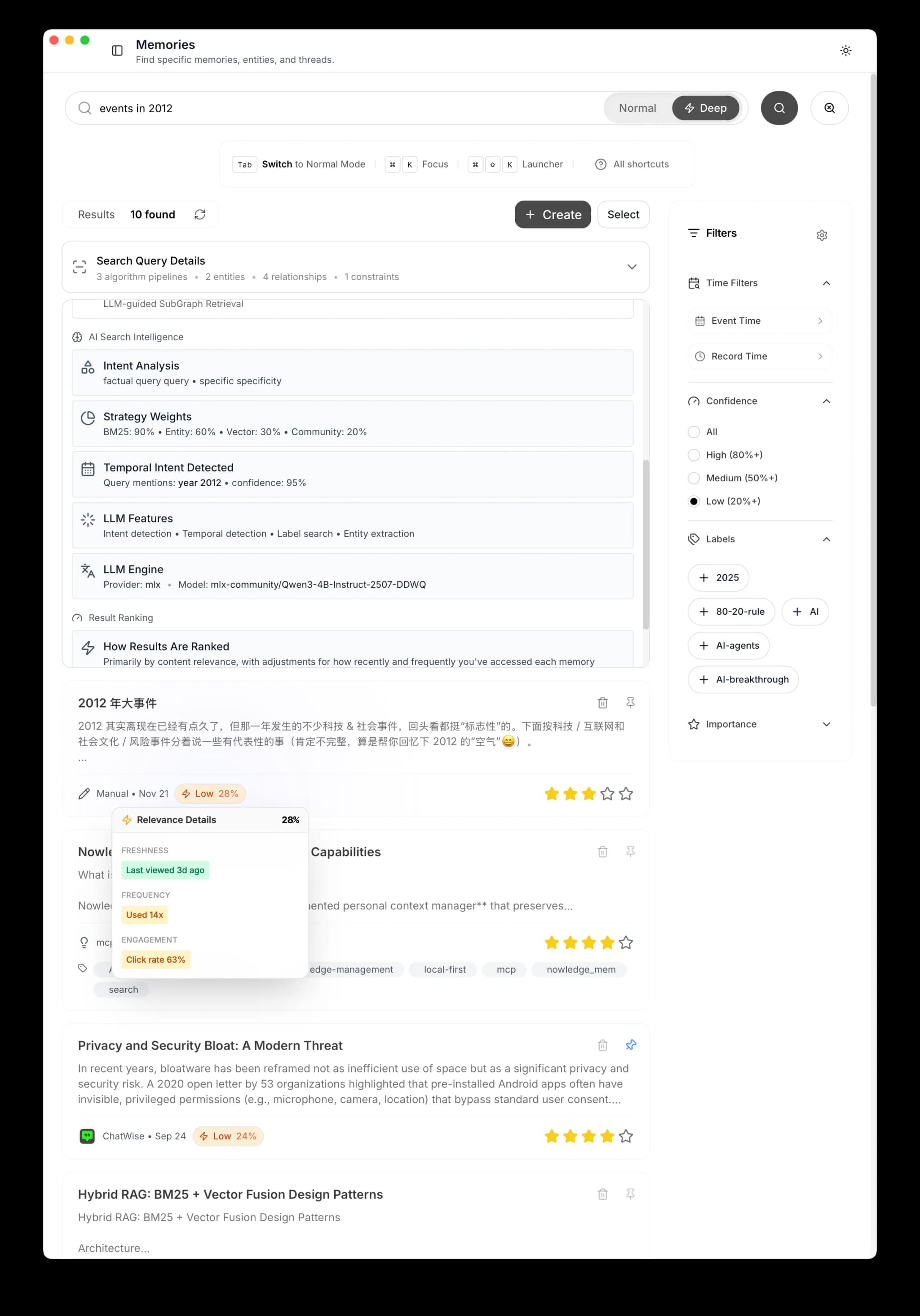
This makes it clear how usage patterns influence ranking and why certain memories appear for specific queries.